Use case

Speed up inventory accounting
with accurate AI

Woodrow reconciles inventory balances, maps movement across systems,
and prepares period-end adjustments—giving your team clean, reviewable outputs on-demand.
Request access
Inventory Accounting: Execution Plan
step 1
Get Warehouse Transactions
Log into the Warehouse Management System and retrieve all inventory movement transactions for the previous month (e.g., receipts, shipments, transfers, adjustments.) Ensure all transaction types are captured...
step 2
Get General Ledger Activity
Retrieve all transactions from the Accounting System for the relevant Inventory GL accounts for the previous month. Group by SKU or transaction class if available. Calculate the net change in value and compare to the expected movement...
Get GL account balances
Execute code with dataset
step 3
Reconcile by Movement Type
Map WMS transactions to GL entries using transaction IDs, POs, or shipment numbers.
Match to Physical Counts
For items with recent cycle counts, compare the system quantity to the counted quantity and flag discrepancies.
Output
Create an Excel sheet
Create an Excel spreadsheet with these tabs: Tab 1: Inventory Movement, Tab 2: GL Activity, 
Tab 3: Exceptions & Adjustments, Tab 4: Journal Entry Draft...
How enterprise teams automate
inventory accounting with Woodrow
Woodrow connects to your inventory and accounting systems, executes your process consistently across every entity and period, and delivers outputs your team can review and post with confidence.
Inventory movement mapping
Pull data from your ERP and warehouse management tools
Trace inventory movement by location, entity, and transaction type
Identify gaps, duplicates, and unmatched activity before close
GL, subledger, and physical count reconciliation
Tie inventory balances by SKU, location, and entity
Flag discrepancies by quantity, price, and cost layer
Produce reconciliation summaries with context attached
Valuation and adjustment prep
Apply your costing methodology consistently across items and entities
Quantify variances and calculate required reserves
Draft journal entries with supporting detail ready for sign-off
INTEGRATIONS
Woodrow integrates with the tools your team relies on
Connect Woodrow to your ERP, warehouse management system, procurement platform, shared drive, or email—and it handles the rest, from pulling inventory data to executing reconciliation steps and delivering documented, audit-ready outputs for review.
Core business software
Finance and operations tools
Payments and data infrastructure
Essential files and documents
Team communications
And any other tools specific to your business.
WHY WOODROW
Made for the pace of enterprise inventory operations
As inventory complexity grows, the margin for error doesn't. Woodrow keeps your process accurate, documented, and on schedule.
Tailored to your business
Woodrow follows your costing methodology and approval rules—producing outputs in the formats your team and auditors already expect.
Built to scale
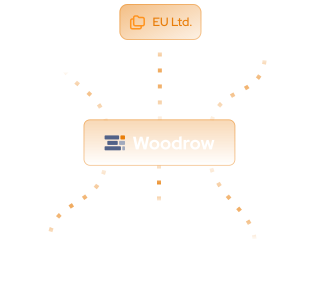
As locations, entities, and SKU counts grow, Woodrow absorbs the additional work, so your accounting team isn't the bottleneck.
Fully auditable
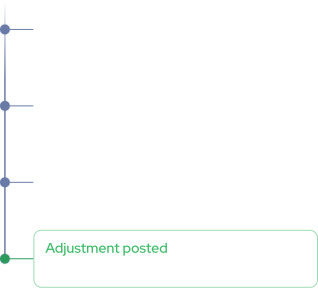
Every action is logged, so reviewers can trace inputs, outputs, and decisions end-to-end without any gaps.

Secure and compliant
Woodrow is SOC 2 Type II certified, with scoped tool permissions, role-based access controls, and zero data retention by default. Your data is never used to train any model.
Learn more about security

Common questions

What systems does Woodrow integrate with for inventory workflows?
Which inventory accounting workflows are a fit for Woodrow?
Can Woodrow support multiple costing methods across entities or product lines?
Can we enforce materiality thresholds and approval rules?
How does Woodrow stay accurate as our inventory processes evolve?